Home/Raccoons
Raccoon Removal in Monroe
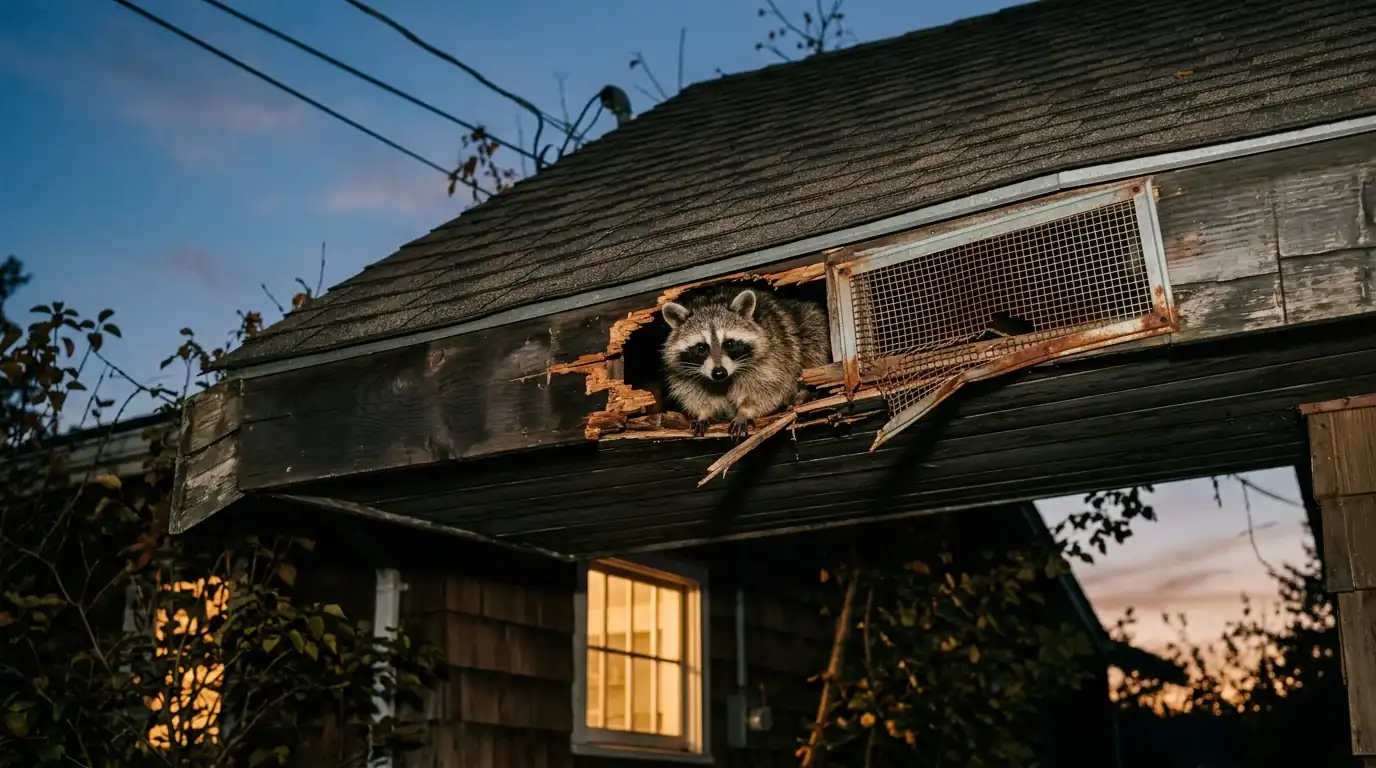
Raccoons tear their own way in, which is why they do more damage to a house than most animals that get inside one.
Bayou and river corridors run right through residential Monroe, and raccoons use them as roads. The practical consequence is that a property backing onto water has a continuous supply: take one out and the territory does not stay empty for long. That is the argument for spending the money on sealing the building rather than on repeated trapping.
Raccoons in Ouachita Parish: who does what
Louisiana Wildlife and Fisheries does not remove nuisance wildlife. It permits operators to do it for a fee, and the permit deliberately excludes four things: deer, bears, migratory birds and alligators. Those need a different route entirely. LDWF also does not lend or rent traps, though some parish animal control offices do keep them, which is worth knowing before you buy one and discover Louisiana requires a licence to use it.
Ouachita Parish Animal Services (417 Well Road, West Monroe; 318-325-0756) describes its job as public safety and health related to both domestic and wild animals.
For identifying an animal or damage before anyone is paid to look, the LSU AgCenter, Ouachita Parish office is at 704 Cypress Street, West Monroe, LA 71291 (office page).
What Louisiana law says about raccoons
A licensed property owner, or a designee with written permission, may trap or shoot a raccoon proven to be causing damage, year-round in daylight, without a permit (LAC 76:V.125); the owner carries the burden of proof, and local firearm ordinances still apply. Louisiana has no closed season on raccoons. Permitted operators may not relocate one: raccoons must be euthanized within 12 hours of capture. All Louisiana rules →
Sources: Ouachita Parish Police Jury, Animal Control; Louisiana Administrative Code Title 76 (wildlife and fisheries); LDWF, Nuisance Wildlife Control and Removal. Checked October 2026.
Signs, and why they matter
- Heavy, deliberate footsteps overhead: raccoons are big enough to sound like a person walking
- Chittering, growling or the distinctive cry of kits, usually at dusk or just before dawn
- A torn soffit, lifted shingles, or a ripped roof or gable vent
- Rabies: raccoons are a primary rabies vector across the southeastern United States
- Raccoon roundworm (Baylisascaris) in the droppings, which is dangerous to people and pets
How removal works
A licensed operator finds every entry point, removes the animal, and critically any kits, which are usually hidden in a wall cavity or soffit and cannot leave on their own, then seals the openings with materials a raccoon cannot tear off. Sealing before the young are out is the most common and most expensive mistake.
Raccoon questions
How much does raccoon removal cost in Monroe?
$300 – $600 for removal; far more if the attic needs restoring, depending on access and whether young are present. After a long stay in an attic the cleanup is often the bigger bill (attic restoration).
Is there a wrong time of year to deal with raccoons?
Spring is the worst time to trap and seal: females den in attics to give birth, and removing the mother while kits remain leaves them to die inside the structure.
Who handles raccoons in Ouachita Parish?
Ouachita Parish Animal Services (417 Well Road, West Monroe; 318-325-0756) describes its job as public safety and health related to both domestic and wild animals.
Request a quote
We read every request and pass it to a licensed wildlife operator covering Monroe where one is available. We are still building our list of operators here, so we cannot promise one is available or say how quickly they will respond.